Hidden Techniques
Hidden techniques are important methods in Sudoku solving that identify elimination opportunities by analyzing the distribution of candidates within regions. Similar to naked sets, hidden sets are core solving techniques essential for tackling Sudoku puzzles.
Hidden Single
A Hidden Single occurs when a candidate only appears in one cell within a region. According to Sudoku rules, this number must be placed once in the region, so it must be placed in the cell.
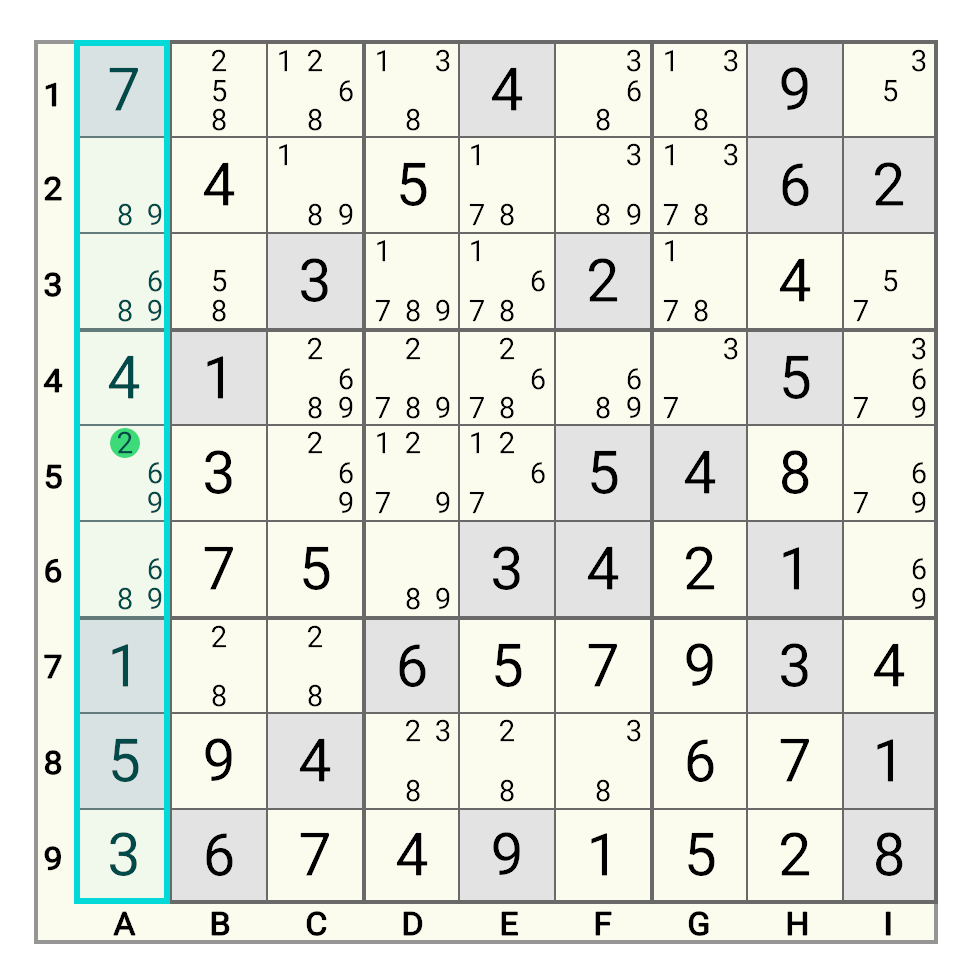
In the image, candidate 2 in Column A (blue region) appears only in cell A5 . According to Sudoku rules, a 2 must be placed in Column A , so A5 must be filled with 2 . This is called a Hidden Single because cell A5 contains multiple candidates, making the answer less obvious.
Hidden Set
A Hidden Set (or Hidden Subset) occurs when n candidates appear in only n cells within the same region, where . Since these n numbers must be placed in these n cells, all other candidates in these cells can be eliminated.
Hidden Single can be viewed as a special case of Hidden Set when .
Hidden Pair
A Hidden Pair is a Hidden Set with . That is, 2 candidates appear in only 2 cells.
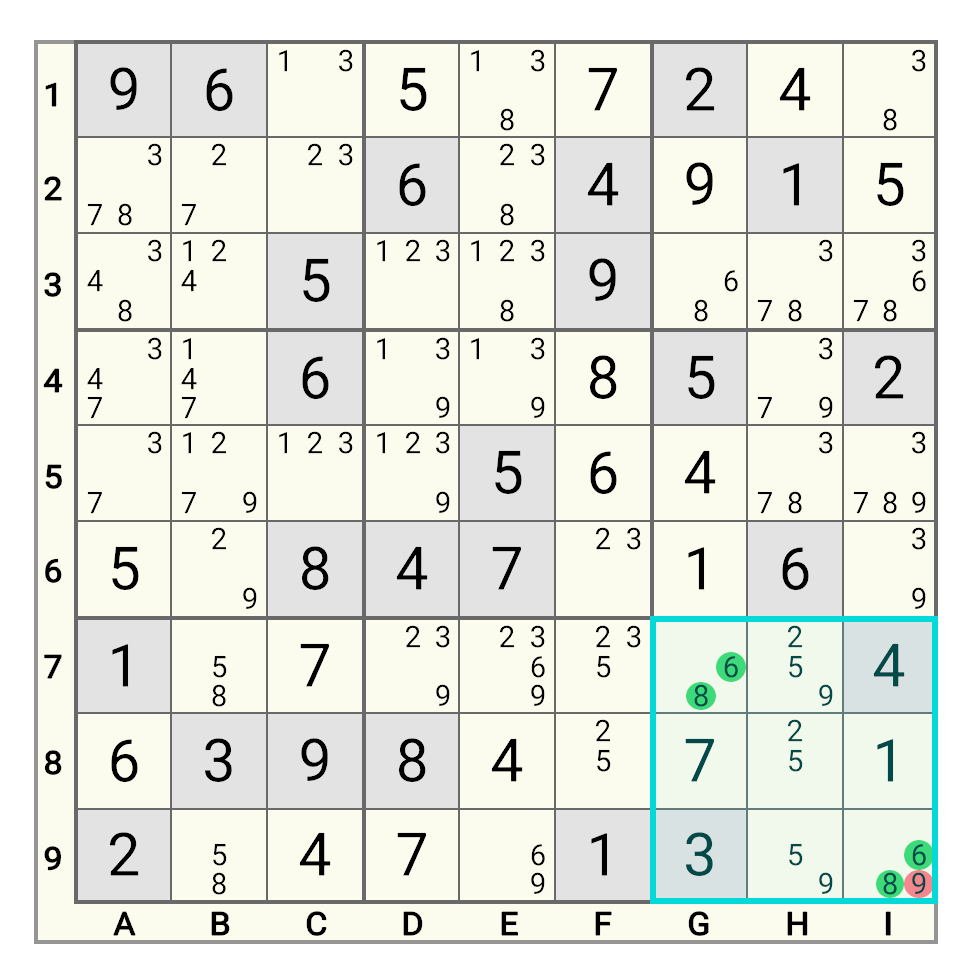
In the image, within Block 9 (blue region), candidates 6 and 8 appear only in cells G7 and I9 . Therefore, these 2 numbers must be placed in these 2 cells, so all other candidates in G7 and I9 can be eliminated.
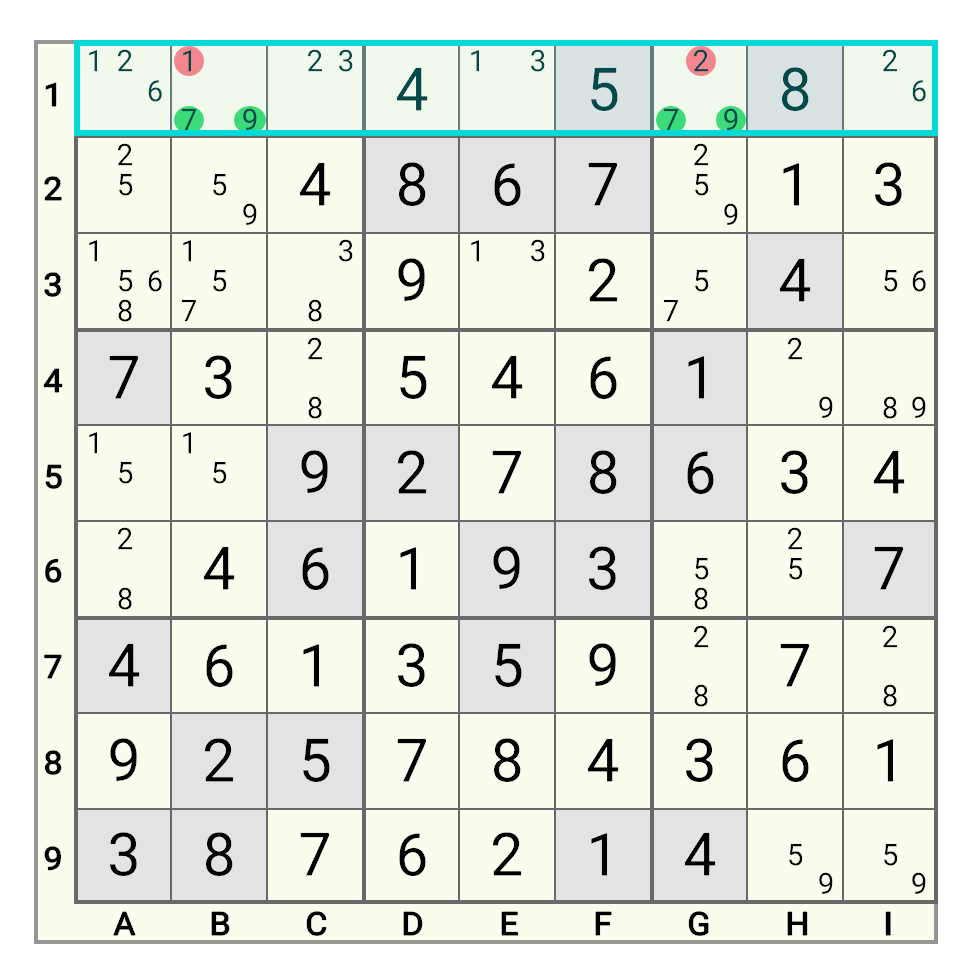
In the image, within Row 1 (blue region), candidates 7 and 9 appear only in cells B1 and G1 . Therefore, these 2 numbers must be placed in these 2 cells, so all other candidates in B1 and G1 can be eliminated.
Hidden Triple
A Hidden Triple is a Hidden Set with . That is, 3 candidates appear in only 3 cells.
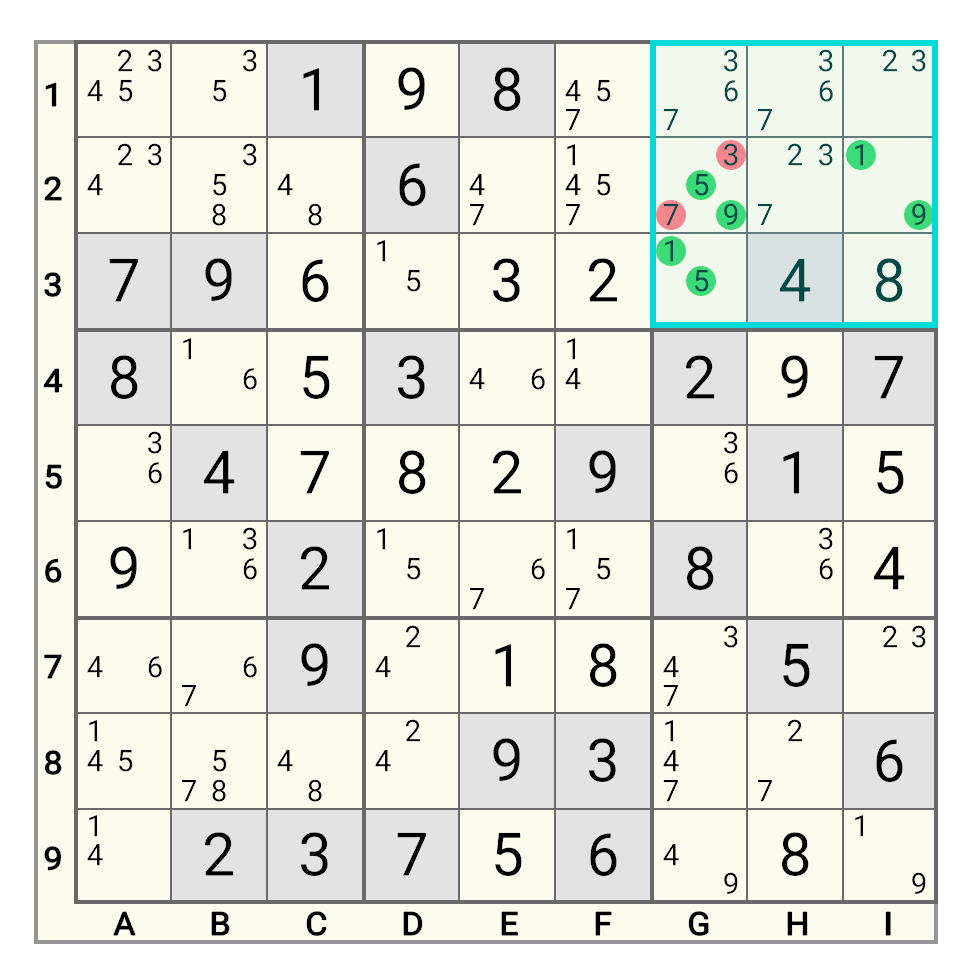
In the image, within Block 3 (blue region), candidates 1 , 5 , and 9 appear only in cells G2 , I2 , and G3 . Therefore, these 3 numbers must be placed in these 3 cells, so all other candidates in G2 , I2 , and G3 can be eliminated.
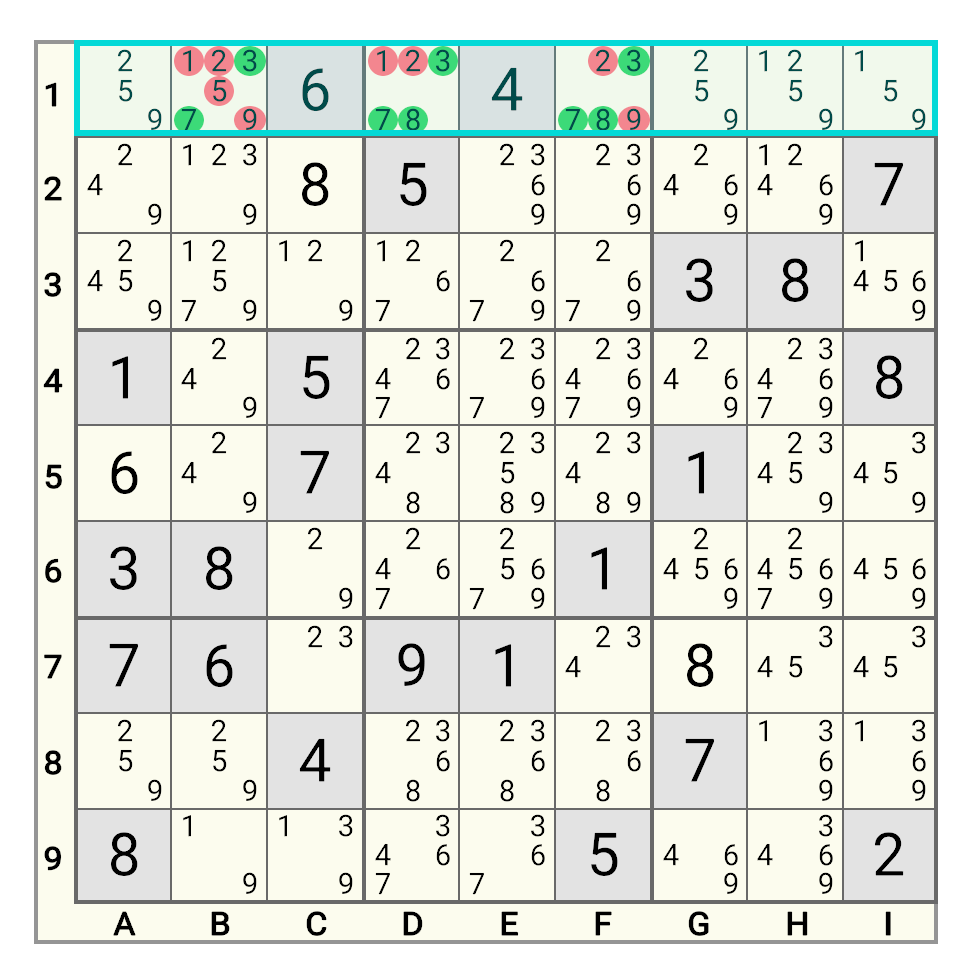
In the image, within Row 1 (blue region), candidates 3 , 7 , and 8 appear only in cells B1 , D1 , and F1 . Therefore, these 3 numbers must be placed in these 3 cells, so all other candidates in B1 , D1 , and F1 can be eliminated.
Hidden Quadruple
A Hidden Quadruple is a Hidden Set with . That is, 4 candidates appear in only 4 cells.
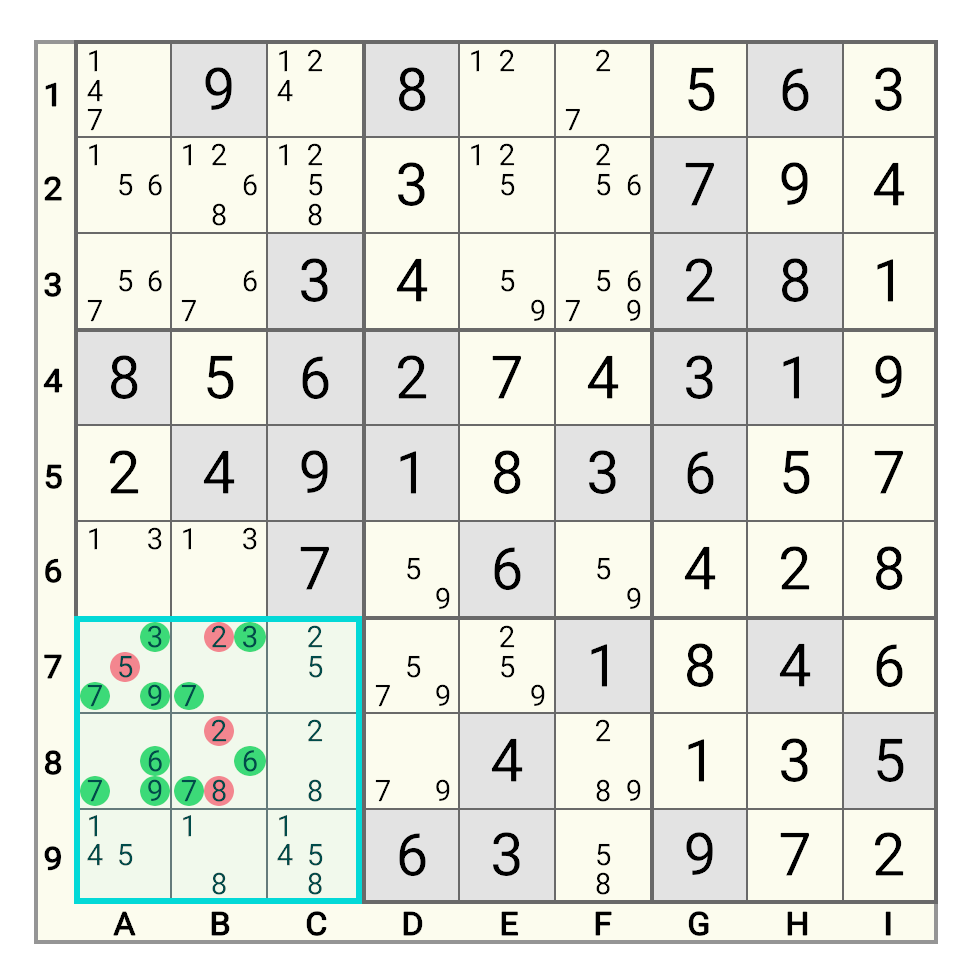
In the image, within Block 7 (blue region), candidates 3 , 6 , 7 , and 9 appear only in cells A7 , B7 , A8 , and B8 . Therefore, these 4 numbers must be placed in these 4 cells, so all other candidates in A7 , B7 , A8 , and B8 can be eliminated.
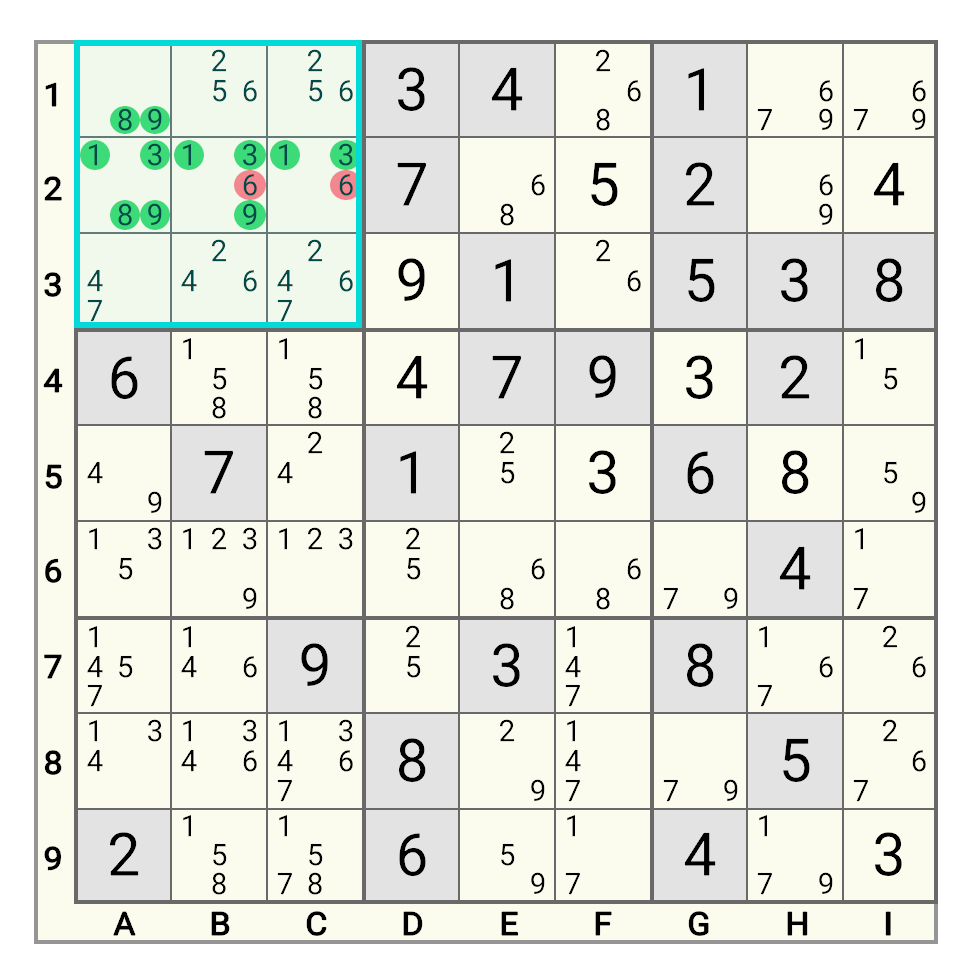
In the image, within Block 1 (blue region), candidates 1 , 3 , 8 , and 9 appear only in cells A1 , A2 , B2 , and C2 . Therefore, these 4 numbers must be placed in these 4 cells, so all other candidates in A1 , A2 , B2 , and C2 can be eliminated.
How to Discover Hidden Sets
Key steps for identifying Hidden Sets :
- Observe candidate distribution : Within a region, look for candidates that appear in only a few cells
- Check for quantity matching : Check if there are n candidates appearing in only n cells:
- 1 number appearing in only 1 cell → Hidden Single
- 2 numbers appearing in only 2 cells → Hidden Pair
- 3 numbers appearing in only 3 cells → Hidden Triple
- 4 numbers appearing in only 4 cells → Hidden Quadruple
- Eliminate other candidates : Once a Hidden Set is found, remove all candidates except the Hidden Set numbers from these cells
Usage Tips
- Search from small to large : Look for Hidden Singles first, then Hidden Pairs , and so on
- Focus on restrictive candidates : Prioritize candidates that appear in only a few cells
- Combine with naked techniques : Hidden Set and Naked Set techniques complement each other and can be used alternately
Complementary Relationship Between Naked and Hidden Sets
You might wonder: why have we never seen examples of naked quintuples, hidden quintuples, and similar techniques in various Sudoku examples?
This is because Naked Set and Hidden Set are complementary concepts in Sudoku, or rather, two different ways of expressing the same elimination logic. When we discover a Naked Set in a region, the other candidates naturally form a Hidden Set ; conversely, when we discover a Hidden Set , the other unfilled cells in the region also form a Naked Set , and they eliminate the same candidates.
Example 1: Naked Triple and Hidden Triple Complement
Naked Set Perspective:
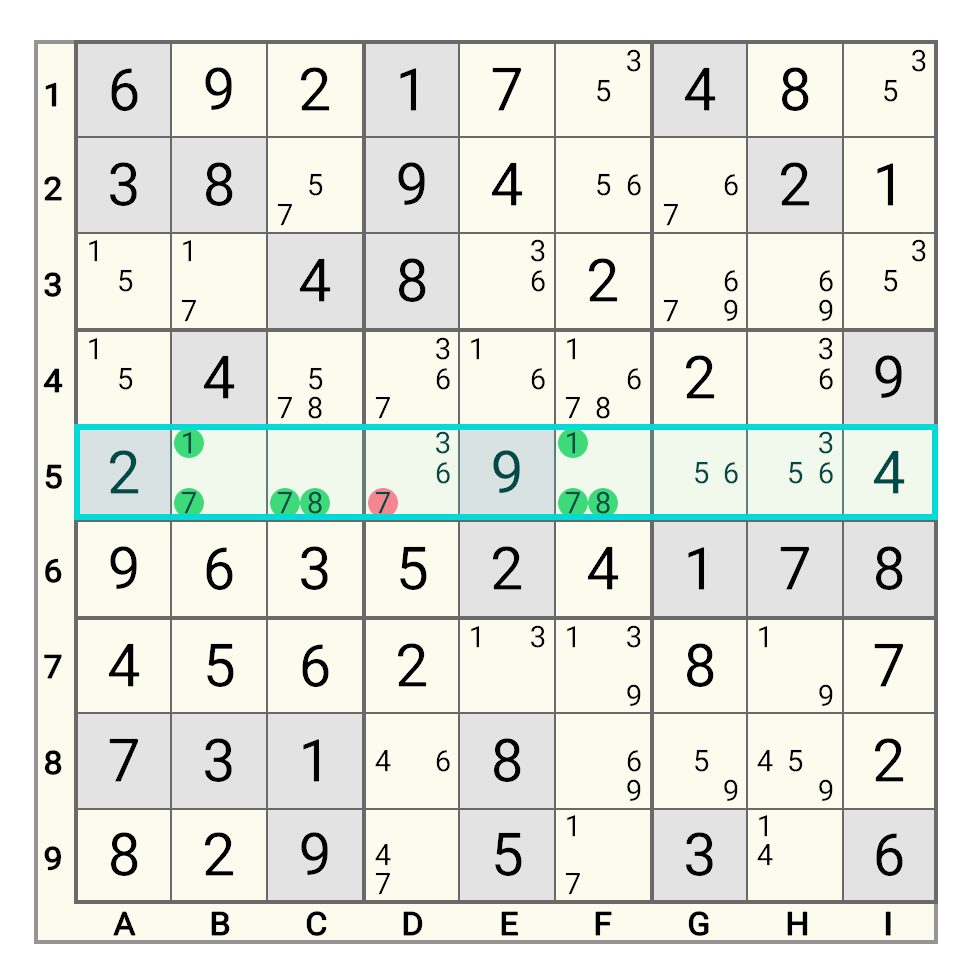
In the image, Row 5 has a Naked Triple : cell set contains candidate set .
Hidden Set Perspective:
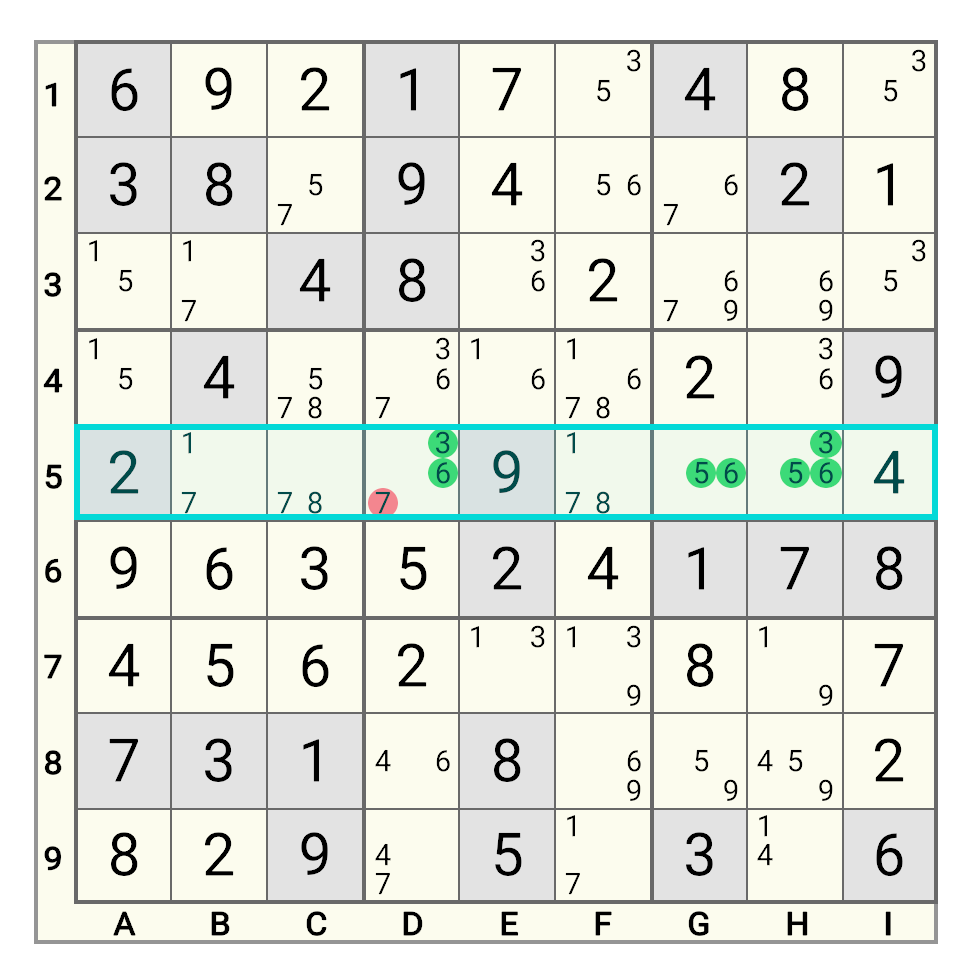
In the same board state, from the hidden set perspective: Row 5 has a Hidden Triple : candidate set appears only in cell set .
You can observe that both perspectives eliminate exactly the same candidates.
Example 2: Hidden Triple and Naked Quadruple Complement
Hidden Set Perspective:
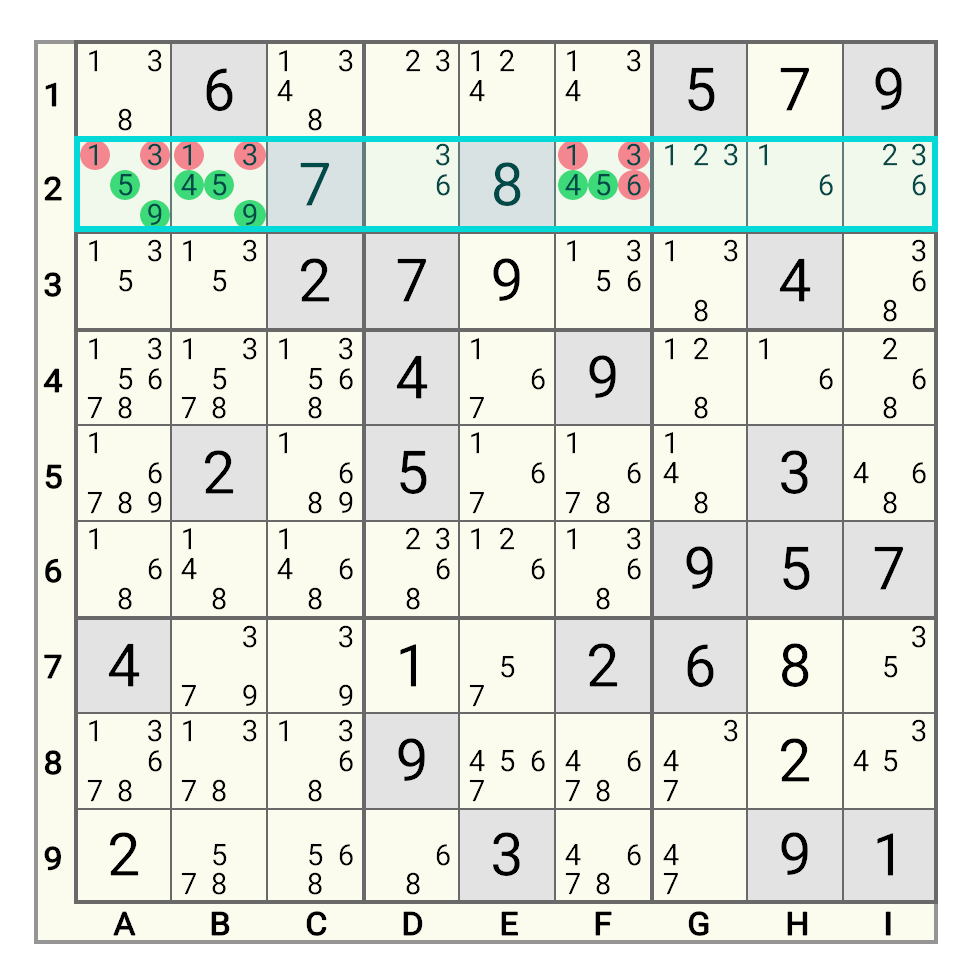
In the image, Row 2 has a Hidden Triple : candidate set appears only in cell set .
Naked Set Perspective:
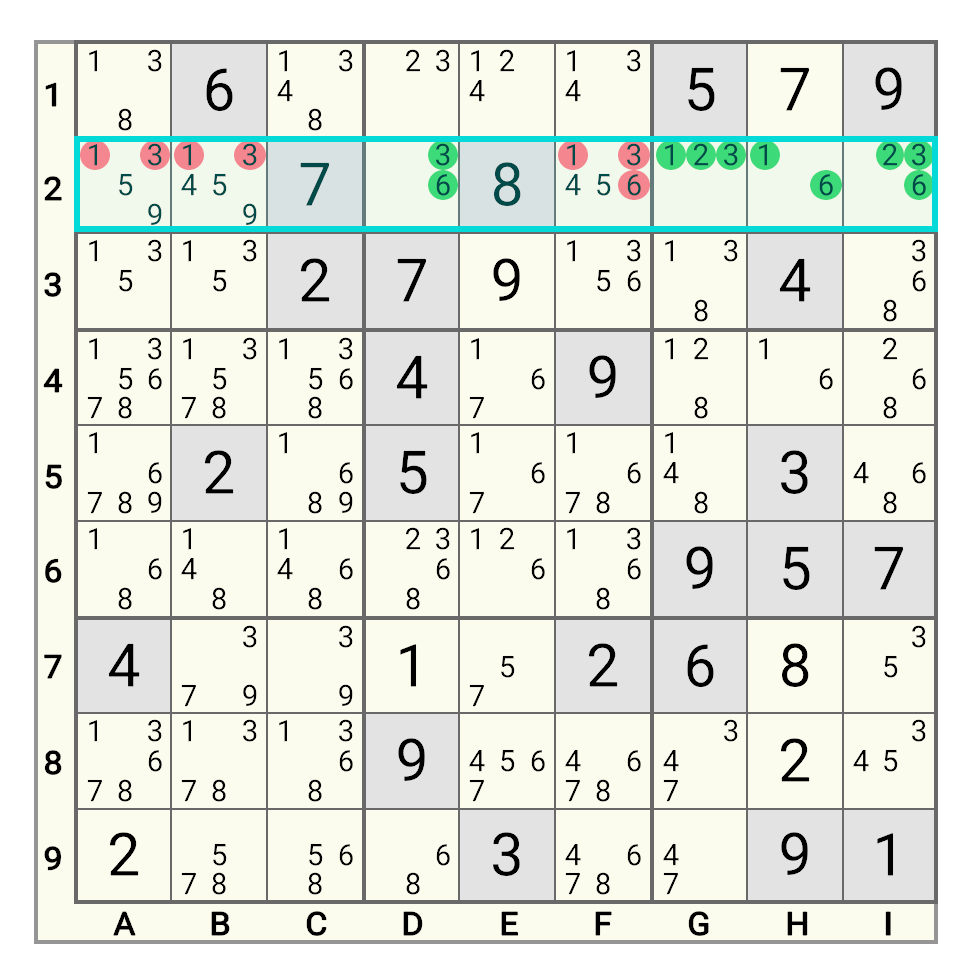
In the same board state, from the naked set perspective: Row 2 has a Naked Quadruple : cell set contains candidate set .
You can observe that they eliminate the same candidates as well.
How to Find Complement Sets
Whether you’ve found a hidden set or a naked set, the other unfilled cells in the same region form its complement set.
Hidden Techniques Theory (Optional)
Definition of Hidden Set
A Hidden Set (the general case, including hidden singles) refers to a non-empty candidate set in region , where the candidates appear only in cell set within that region, and .
Proof of Hidden Set Technique
Proposition : In region , if there exists a candidate set that appears only in cell set within region , forming a hidden set, then:
- Numbers in must be placed in cells in , with each number placed exactly once
- Candidates in cell set that do not belong to can be eliminated
Proof :
According to the definition of Hidden Set, candidates in appear only in cells in within region .
According to Sudoku rules, therefore, each number in must be placed in some cell in .
Since and each cell must be filled with one number, each number in must be placed in exactly one cell in .
Therefore, cells in cannot be filled with numbers that don’t belong to .
Therefore, candidates in cells in that do not belong to can all be eliminated.
Complement
Proof that the Complement of a Naked Set is a Hidden Set
Proposition :
In region , let be the set of unfilled cells in that region, with candidate set , where obviously . If cell set forms a naked set with candidate set , let the remaining cell set be , and let the remaining candidates be , then candidate set forms a hidden set in cell set .
Proof :
Note that is not the candidate set of
According to the definition of , candidates in do not appear in filled cells, nor do they appear in . Therefore, candidates in appear only in within region .
And
Since
Also, according to the definition of naked sets,
Therefore
Therefore, candidates in appear only in within region , and , which is the definition of a hidden set.
Therefore, candidate set forms a hidden set in cell set .
Proof that the Complement of a Hidden Set is a Naked Set
Proposition :
In region , let be the set of all unfilled cells in that region, with candidate set , where obviously . If candidate set forms a hidden set in , let the remaining cell set be , then is a naked set.
Proof :
Let the candidate set of be
According to the definition of Hidden Set, candidates in appear only in within region
Therefore these candidates do not appear in
Therefore
Therefore
Now let’s calculate the set sizes:
Since , we have:
Since
Also, according to the definition of Hidden Set,
Therefore
Clearly, if , the Sudoku has no solution, so:
.
This is the definition of a naked set. Therefore is a naked set.