Chain Techniques (Advanced)
X-Chain
Overview
The Alternating Inference Chain (AIC) is an essential technique for intermediate players, often the key to cracking difficult puzzles. We’ll start with the X-Chain , a basic form of AIC . Mastering the X-Chain will build a solid foundation for understanding other AIC techniques.
Basic Concepts
Before diving into the X-Chain , we need to understand a few core concepts: See , Strong Link , Weak Link , and AIC .
See
See is a fundamental concept in Sudoku, frequently used when discussing elimination logic.
When two cells are in the same region , we say they can see each other.
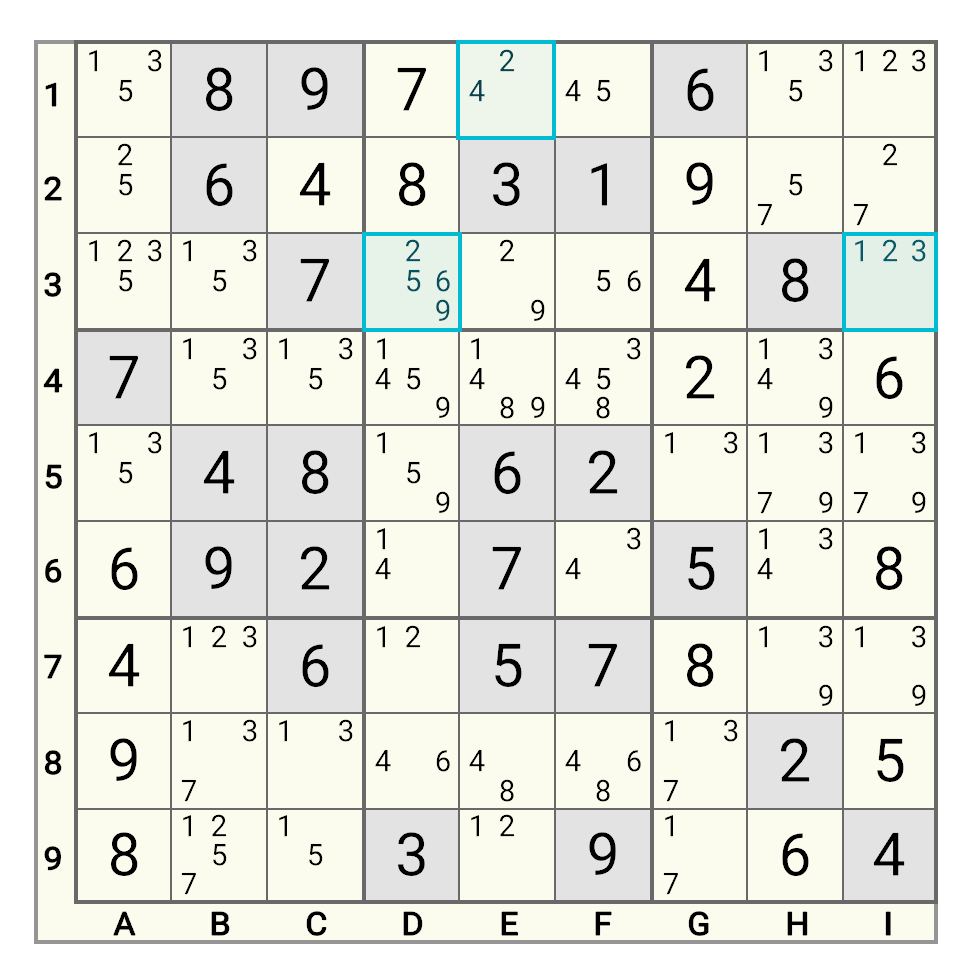
In the image:
- Cell D3 and cell E1 are both in Block 2 , so they can see each other.
- Cell D3 and cell I3 are both in Row 3 , so they also can see each other.
- However, cell E1 and cell I3 do not share any common region, so they cannot see each other.
Note: A cell cannot see itself.
Strong Link
When two assumptions have an “if not a, then b” relationship, we call it a Strong Link .
Definition: **If ** a ** is ** false **, then ** b ** must be ** true . This forms a Strong Link from a to b .
Notation: a = b (The equals sign here does not imply mathematical equality, nor does it imply symmetry—meaning a = b does not necessarily imply b = a ).
Let’s look at two common scenarios where Strong Links occur in standard Sudoku.
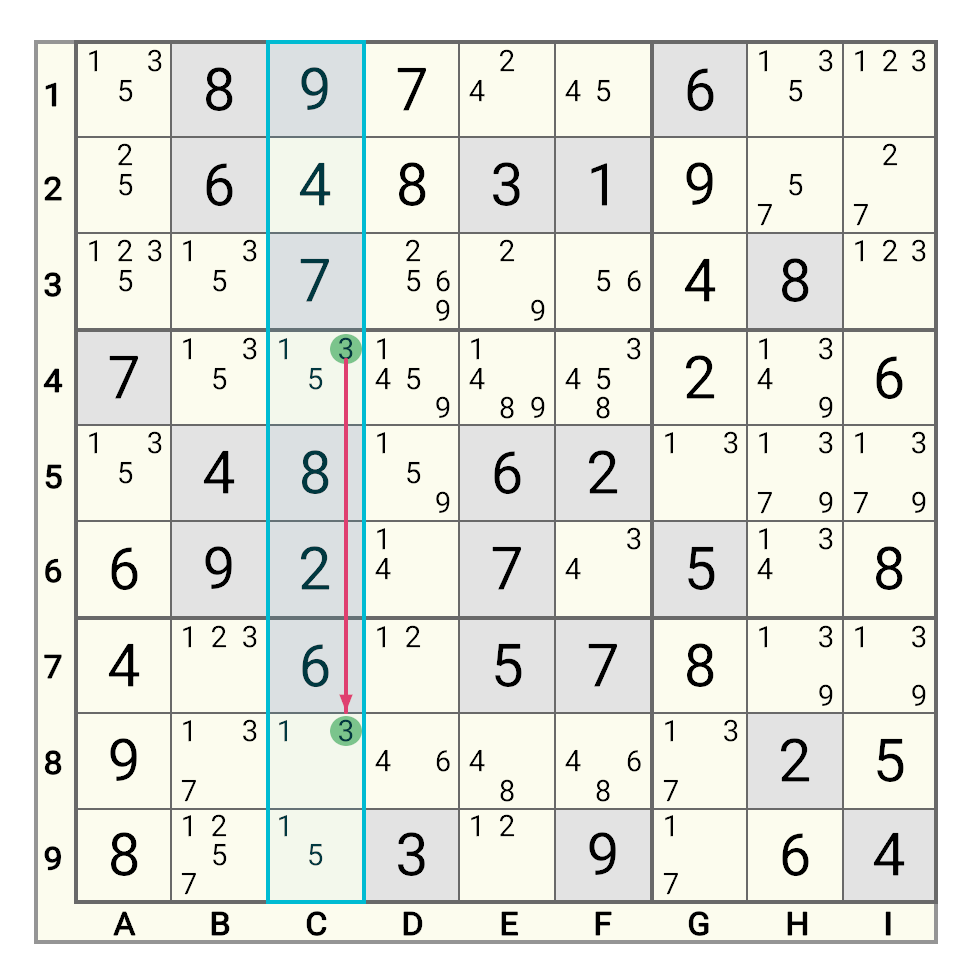
In the image, candidate 3 in C4 ( C4/3 ) and C8 ( C8/3 ) forms a Strong Link , denoted as C4/3 = C8/3 .
In Column C (blue area), the candidate 3 only appears in cells C4 and C8 . Since 3 must be placed exactly once in this column, at least one of these two cells must contain 3 .
Therefore, if C4/3 is false (i.e., C4 is not 3 ), then C8/3 must be true (i.e., C8 is 3 ). This fits the definition of a Strong Link , yielding C4/3 = C8/3 .
The reverse is also a Strong Link : C8/3 = C4/3 .
This scenario occurs when a candidate appears in only two cells within the same region, forming Strong Links .
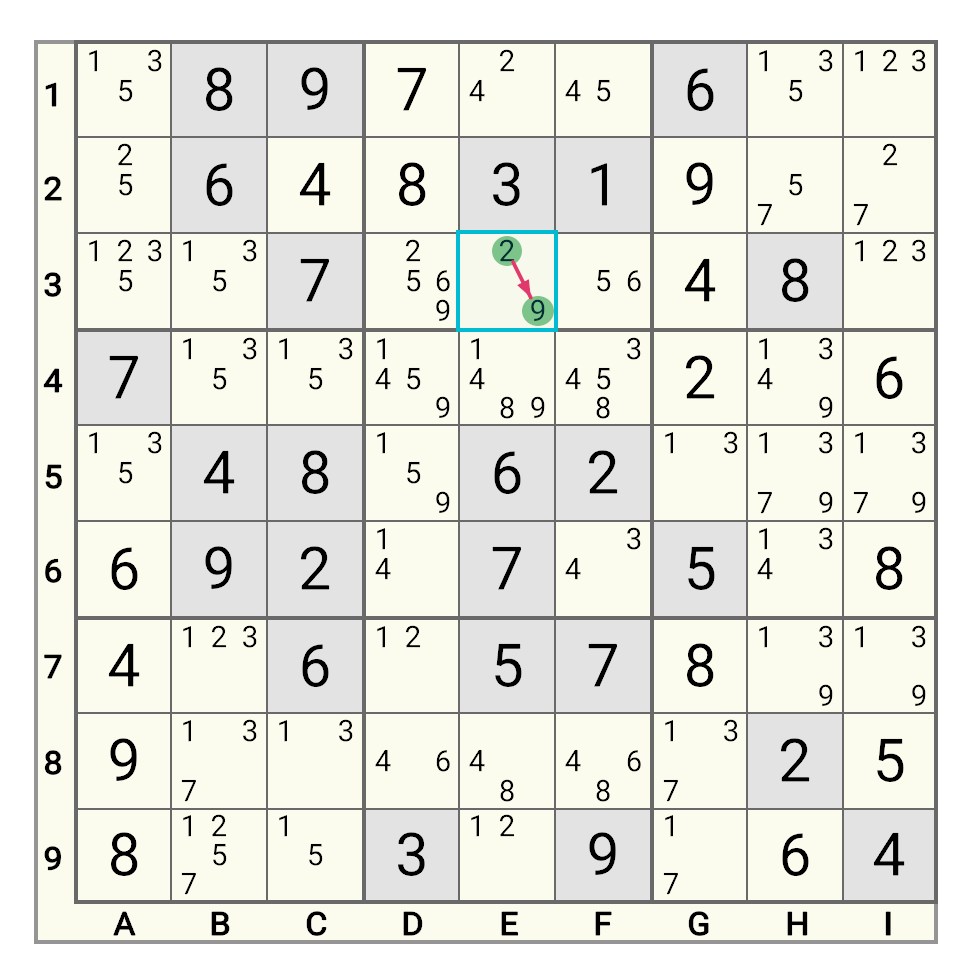
In this image, cell E3 (blue cell) contains only two candidates: 2 and 9 . At least one of these two candidates must be true , meaning E3 must be either 2 or 9 .
If E3/2 is false (i.e., E3 is not 2 ), then E3/9 is true (i.e., E3 is 9 ). This fits the definition of a Strong Link , yielding E3/2 = E3/9 .
The reverse is also a Strong Link : E3/9 = E3/2 .
This scenario occurs when a cell contains only two candidates, forming Strong Links .
Weak Link
When two assumptions have an “if a is true, then b is false” relationship, we call it a Weak Link .
Definition: **If ** a ** is ** true **, then ** b ** must be ** false . This forms a Weak Link from a to b .
Notation: a - b
Let’s look at two scenarios for Weak Links .
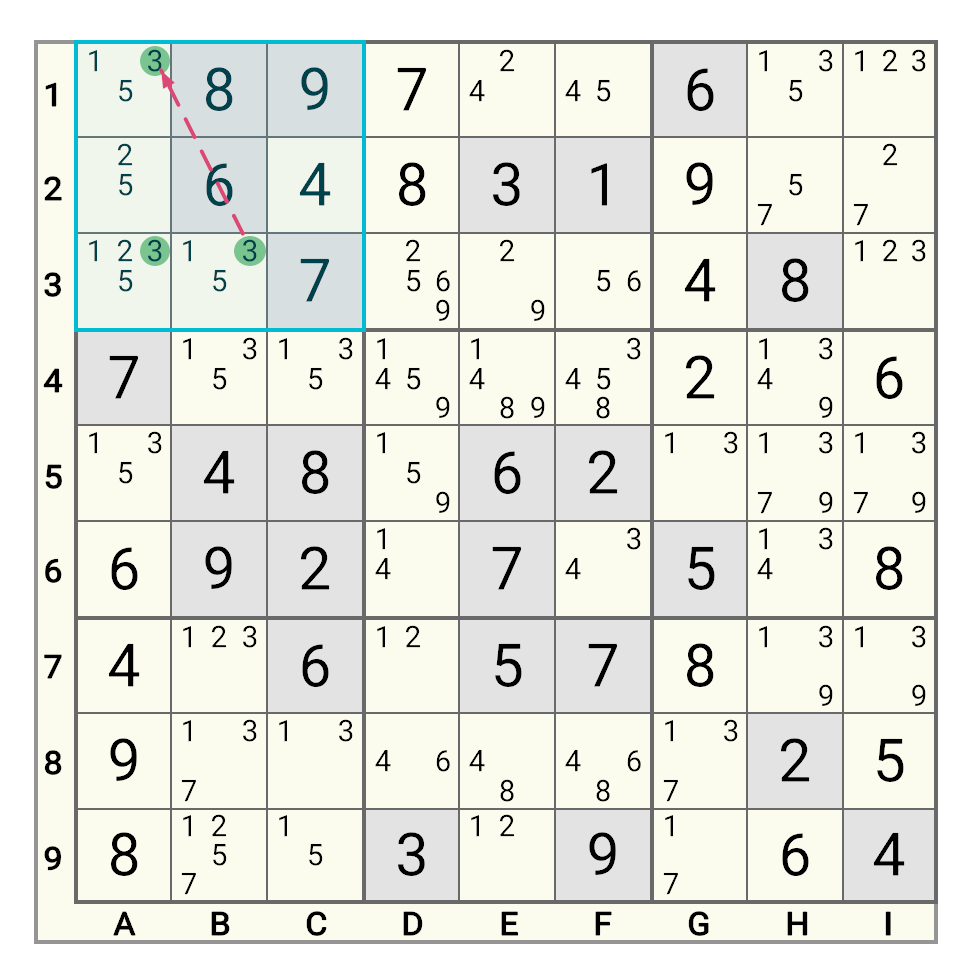
In the image, observe the distribution of candidate 3 in Block 1 (blue area). Cells A1 , A3 , and B3 all contain candidate 3 (green candidates). According to Sudoku rules, 3 can only be placed once in Block 1 . Thus, only one of these 3 candidates can be true .
If any one candidate is true , the other two must be false . This fits the definition of a Weak Link . Therefore, any two candidates here can form a Weak Link .
The image shows the Weak Link : B3/3 - A1/3 .
This applies when a candidate appears multiple times (at least twice) in the same region.
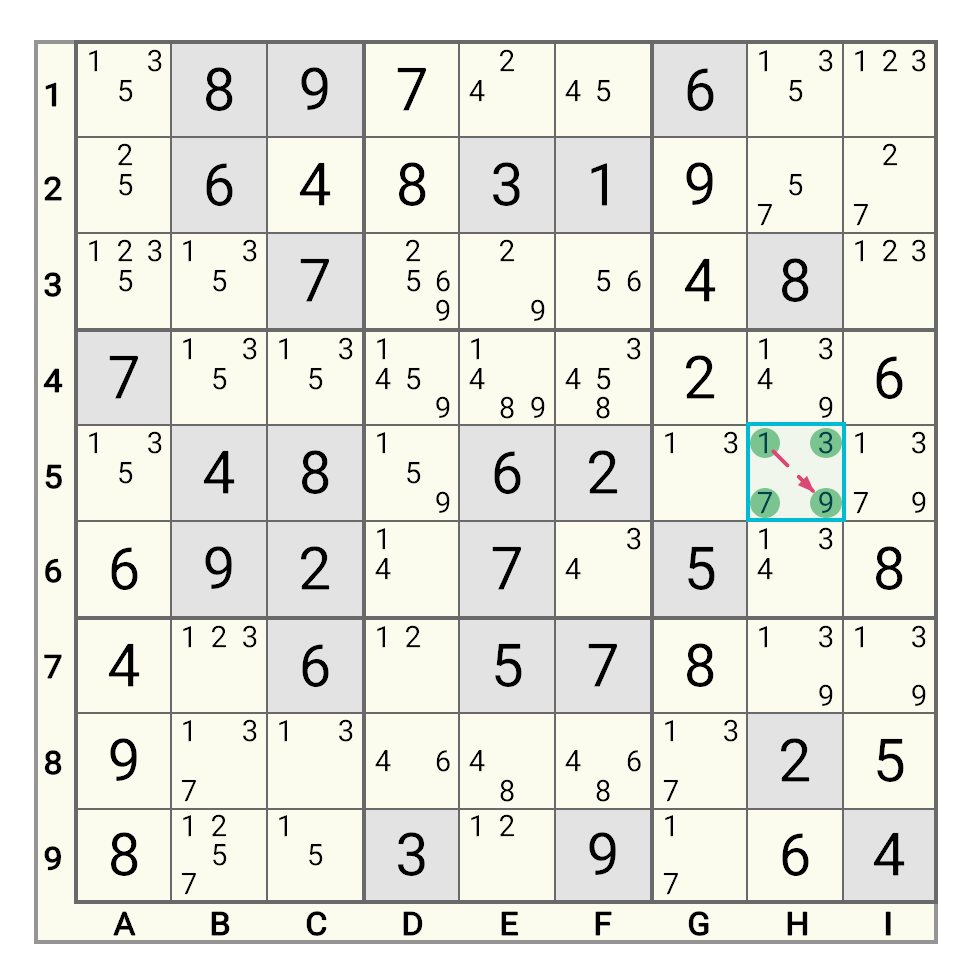
In the image, cell H5 (blue cell) has four candidates: 1 , 3 , 7 , and 9 . Only one of them can be true .
If any one candidate is true , then the others must be false . This fits the definition of a Weak Link , so any two candidates here can form a Weak Link .
The image shows the Weak Link : H5/1 - H5/9 .
This applies when a cell has multiple candidates (at least two).
Alternating Inference Chain (AIC)
By connecting Strong Links and Weak Links in an alternating fashion, we form an Alternating Inference Chain (AIC).
Example: a = b - c = d
Note: Each letter in the chain represents an assumption or a candidate.
From this chain, we can derive a Strong Link : a = d . Here’s the logic:
First, assume a is false .
According to the Strong Link a = b , if a is false , then b must be true .
According to the Weak Link b - c , if b is true , then c must be false .
Finally, according to the Strong Link c = d , if c is false , then d must be true .
We started with the assumption that a is false and concluded that d must be true . This fits the definition of a Strong Link , so a = d .
General Rule: In any chain where the first and last links are Strong Links , and the intermediate links alternate between weak and strong, the start and end points form a Strong Link . If the start is false , the end must be true .
X-Chain
An X-Chain is a special case of AIC that involves only a single digit . Since it focuses on one number, it’s also called a Single Digit Chain .
Crucially, an X-Chain must start and end with a Strong Link .
General X-Chain
The image below shows an X-Chain of length 5 (length refers to the number of links).
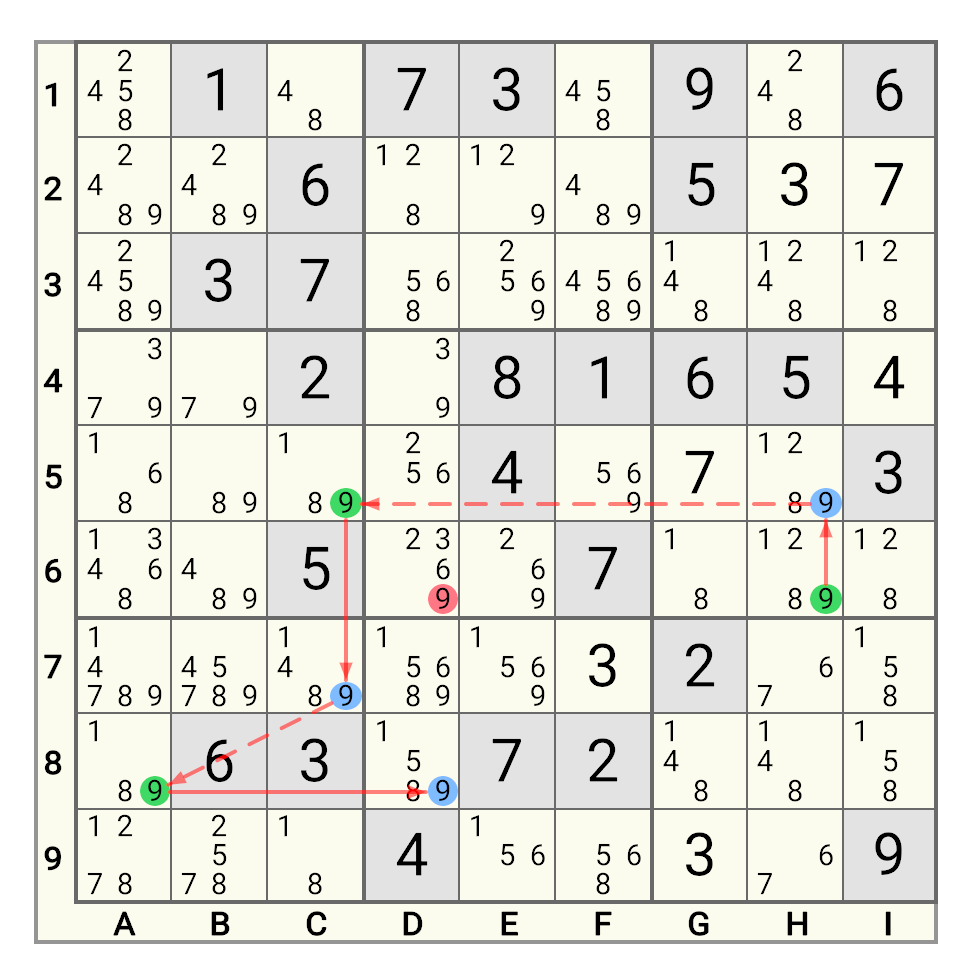
The chain is: H6/9 = H5/9 - C5/9 = C7/9 - A8/9 = D8/9
Using AIC logic, we derive the Strong Link : H6/9 = D8/9 .
This means if H6 is not 9 , D8 must be 9 . In other words, one of these two cells must contain 9 . Consequently, any cell that can see both H6 and D8 cannot contain 9 . In this case, we can eliminate candidate 9 from cell D6 .
Turbot Fish
When an X-Chain has a length of 3, it is known as a Turbot Fish . This is the shortest possible X-Chain .
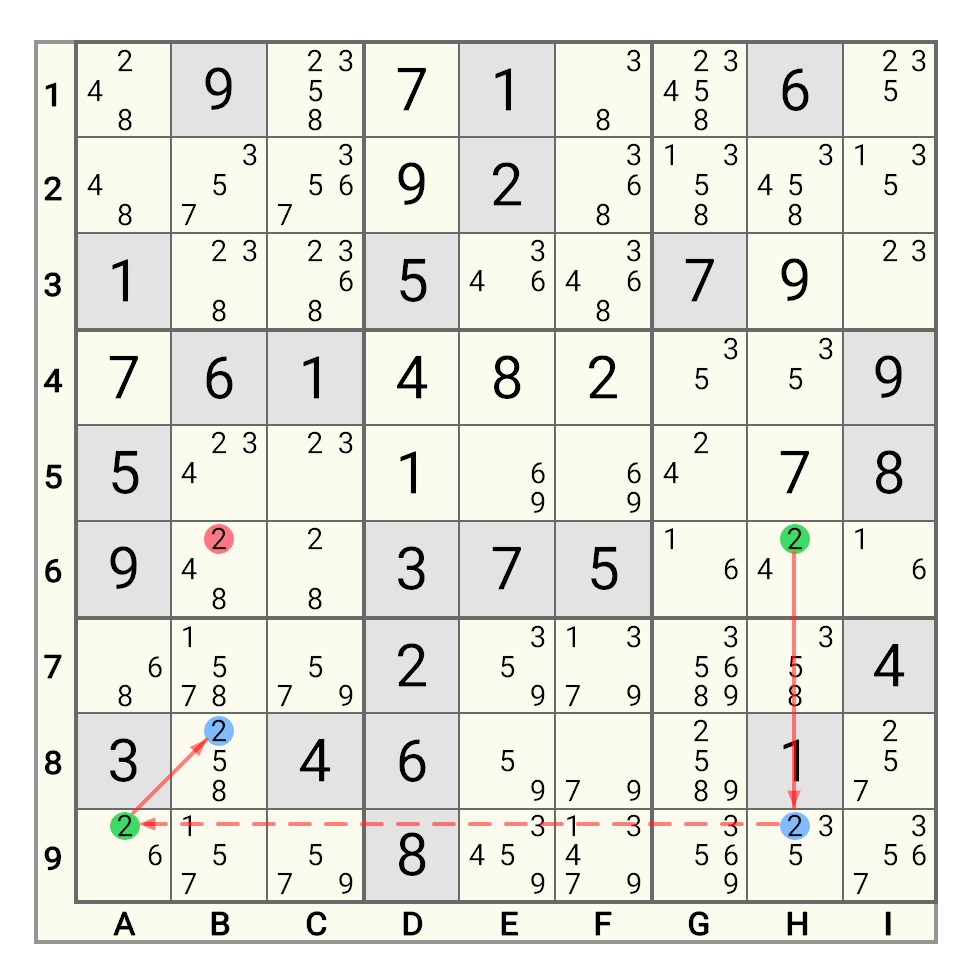
The chain is: H6/2 = H9/2 - A9/2 = B8/2
Derived Strong Link : H6/2 = B8/2
One of H6 or B8 must be 2 . Therefore, B6 cannot be 2 because it can see both H6 and B8 .
Skyscraper
A Skyscraper is a special case of Turbot Fish where the two Strong Links are Column Links (or Row Links ), and the connecting Weak Link is a Row Link (or Column Link ).
Note :
- Row Link : A link formed by the same candidate within a Row .
- Column Link : A link formed by the same candidate within a Column .
- Block Link : A link formed by the same candidate within a Block .
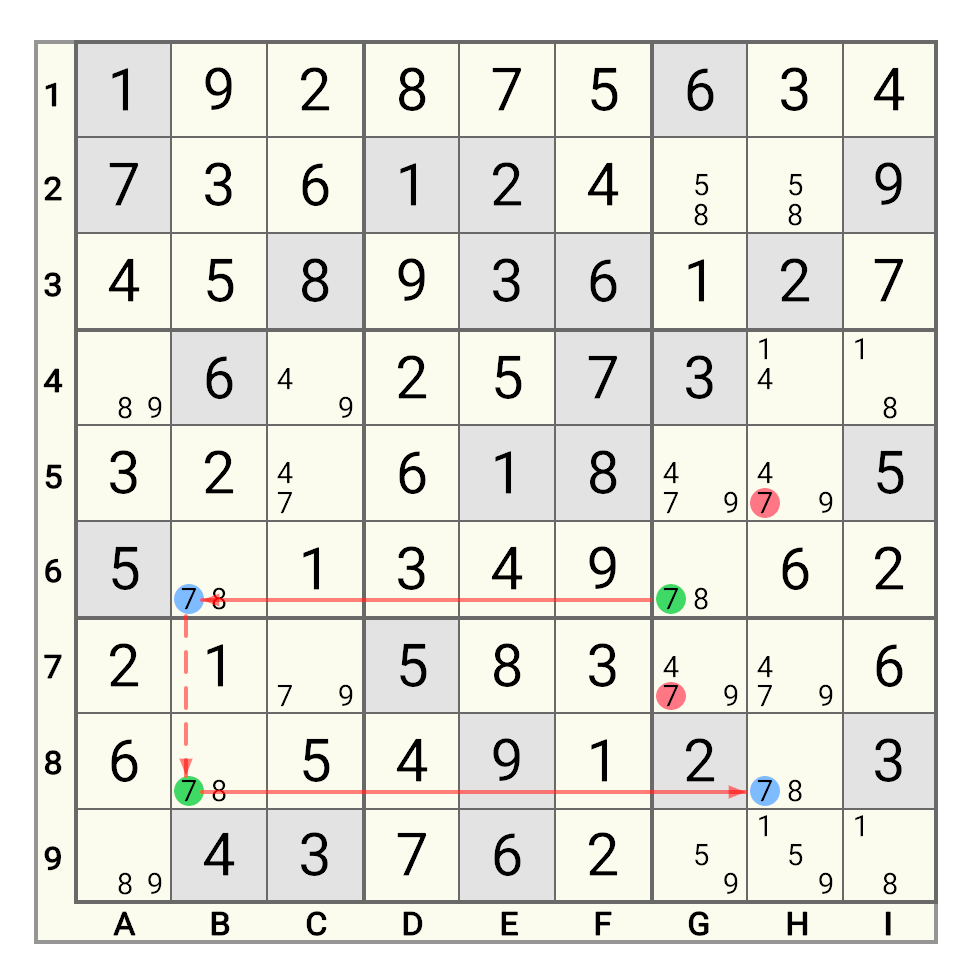
Chain: G6/7 = B6/7 - B8/7 = H8/7
We can eliminate 7 from G7 and H5 .
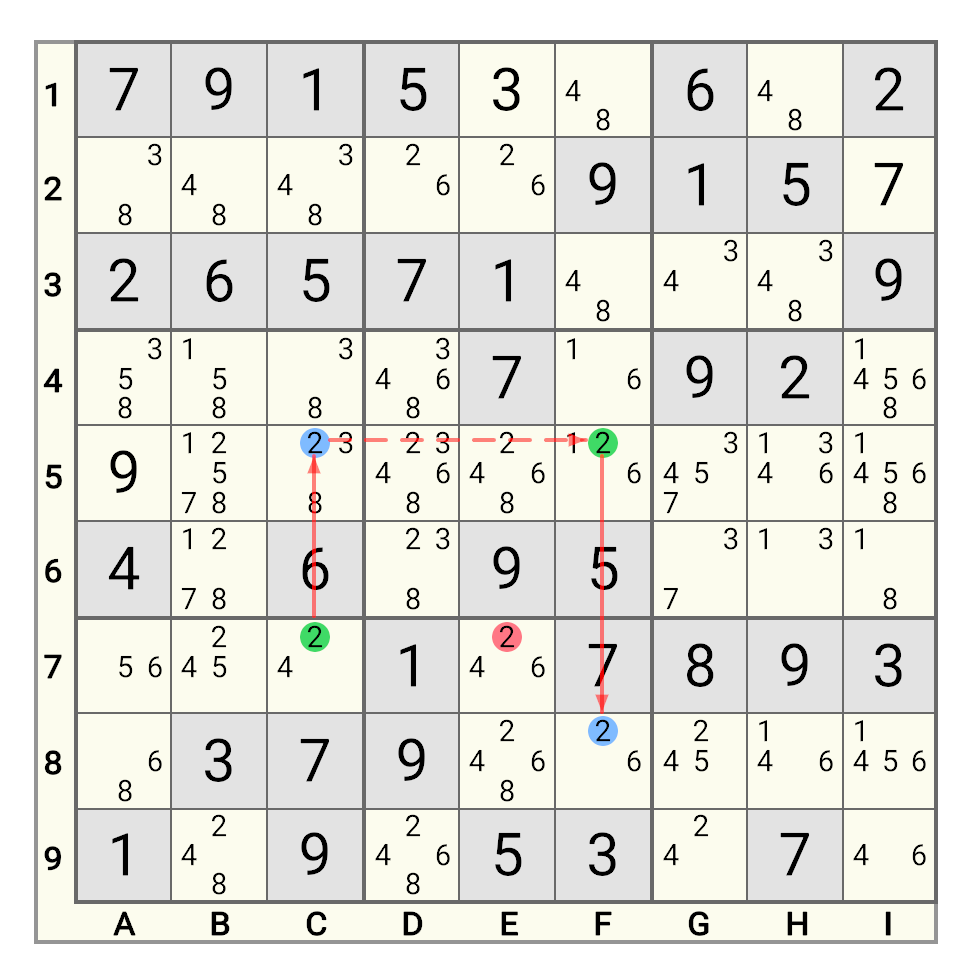
Chain: C7/2 = C5/2 - F5/2 = F8/2
We can eliminate 2 from E7 .
Two-String Kite
A Two-String Kite is another special case of Turbot Fish where one Strong Link is a Row Link and the other is a Column Link , connected by a Weak Link that is a Block Link .
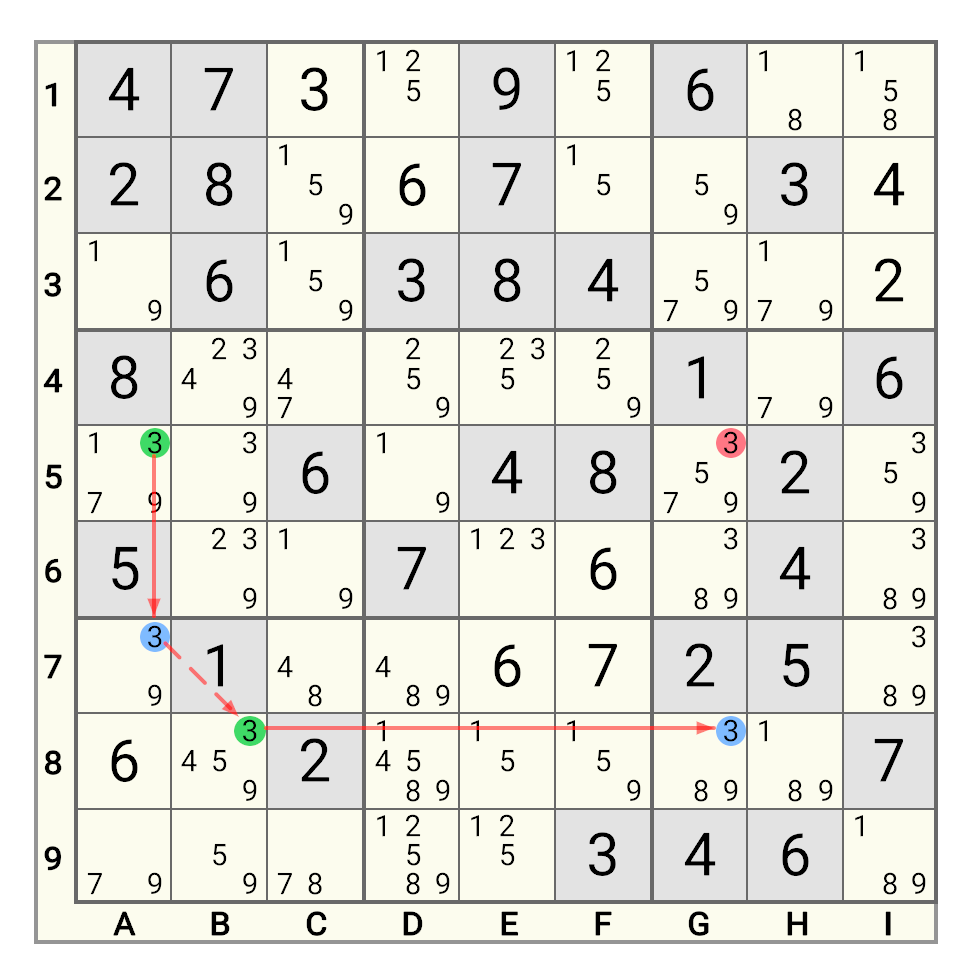
Chain: A5/3 = A7/3 - B8/3 = G8/3
We can eliminate 3 from G5 .
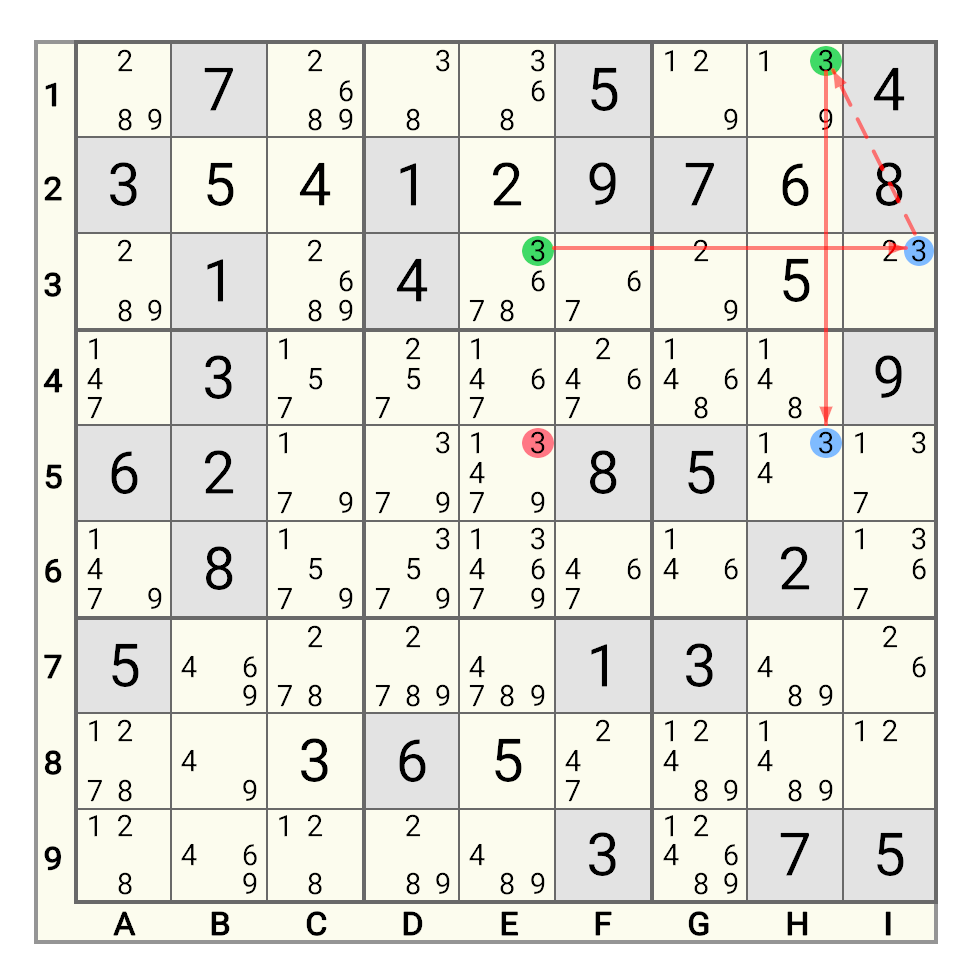
Chain: E3/3 = I3/3 - H1/3 = H5/3
We can eliminate 3 from E5 .